I suppose it was inevitable that, in a broadcast on the theme of ‘reconciliation’, the Queen would celebrate the informal truce that spontaneously broke out in the trenches between British and German soldiers in the First World War at Christmas-time 1914; and we have had the Sainsbury’s television advert over the last month or so to give some vivid visual imagery to this evocation (with football thrown in too, which the Queen did not mention). It’s good that there was such a truce, of course; at least it stopped the industrial-scale carnage for a few hours.
But if only it had gone much further. In his 1914 pamphlet ‘Common Sense about the War’, George Bernard Shaw recommended that the troops on both sides should shoot their own officers and go home and get the harvest in. Lenin knew that you had to go one stage further still and shoot your political leaders too. For him, you should take the weapons the ruling class gave you and turn them, not against each other, but against those ruling classes themselves, turning international wars into civil wars. So never mind cheery Christmas football, it would have taken uprisings on this scale by ordinary troops to bring down the capitalist elites whose competing imperialisms caused the unprecedented mass-slaughter.
As I've noted previously in this blog, my grandfather Henry Smith Pinkney fought with the Royal Artillery in France in the Great War, and though he didn’t actually turn his guns on officers or rulers, he did later join the Communist Party of Great Britain, which I take it was his way of saying that you had to hate and fight the entire economic system that had sent working men out to die in their millions to protect its imperialist super-profits. If you do not name, hate and fight that system, if you only mourn the deaths of so many individuals – the ‘fallen’ or the ‘warriors’ who ‘made the ultimate sacrifice', in that repulsive late-Victorian rhetoric - then you can have an enjoyably poignant emotional wallow, as did all those who admired the great flood of poppies at the Tower of London, but you show no real respect at all to those who have died in capitalism’s wars, then or since. I guess we are going to have to repeat these points frequently over the next three or four years!
Thursday, 25 December 2014
Wednesday, 17 December 2014
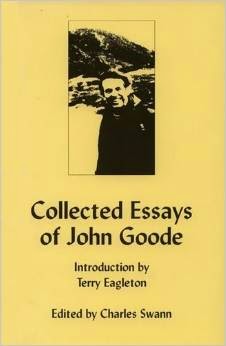
Teachers of Lore 2: John Goode
In June 1978 John Goode interviewed me for a place on the MA in Literature course at Warwick University, where I met my wife Makiko Minow, and at the end of that academic year he sent me down the road to Oxford to work with Terry Eagleton, so he certainly played a major role in shaping my personal, professional and political life. He co-taught literary theory to us on the Warwick MA course, and I did not then fully grasp what an important nineteenth-century scholar and critic he was. It was only later at Oxford, as my own thoughts turned to William Morris, that I began to take the measure of Goode’s significance as a Morris scholar in particular. His work mattered so much because – unusually among that generation of Morris critics – he brought the lessons of the ‘theory revolution’ of the 1980s to bear upon News from Nowhere and other key works. Under the impact of Louis Althusser and Pierre Macherey, he had moved from a ‘reflectionist’ to a ‘productionist’ concept of the literary text, and he produced his most important work on Morris in the light of the latter.
I attended John Goode’s inaugural professorial lecture at Keele University in February 1992, and learnt of his death in January 1994 at the age of fifty-four with great sadness. I heard later from Keele colleague Charles Swann that on his death-bed John had been reading, in such moments of respite as he had, Henry James’s The Wings of the Dove and volume two of Jürgen Habermas’s Theory of Communicative Action, both immensely formidable texts in their different ways even if you were in the very best of health. So he leaves us not only an important body of writing about Hardy, Gissing, Clough, Morris and other Victorian literature topics (partly gathered in the Collected Essays of 1995), but also that moving example of intellectual dedication even in the face of great adversity.
Sunday, 30 November 2014
Jeremy Deller's Colossus
I’m not so sure about Jeremy Deller’s painting of a giant William Morris hurling Roman Abramovich’s yacht Luna to the bottom of the ocean, grand ebullient image though it most certainly is. Firstly, the painting plays into a familiar stereotype of Morris’s eccentric rages and tantrums, as when ‘at Red Lion Square he hurled a fifteenth-century folio, which in ordinary circumstances he would hardly have allowed any one but himself to touch, at the head of an offending workman. It missed the workman and drove a panel out of the workshop door’ (Mackail, I, 215). Deller’s image of Morris manhandling the Abramovich yacht thus risks reducing politics to personality, or even pathology (Shaw believed that Morris at such moments suffered from a form of epilepsy).
Secondly, if we do interpret the painting politically, it strikes me as dramatising an individualist-anarchist gesture, a terroristic ‘propaganda by deed’ of the kind against which Morris himself polemicised vigorously in the 1880s and 90s, recommending in its place the slow, patient, frustrating but essential work of building up a collective socialist movement (though to articulate that is perhaps more a task for narrative than image). Thirdly, though I too certainly want to take Abramovich’s yacht out of private super-rich ownership, I don’t want to send it plunging to the bottom of the sea, even in fantasy, but rather to turn it into a floating oceanographic research institute, staffed with unemployed youngsters from east London investigating the effects of global warming upon marine life - roughly on the model of the ship Ganesh in Kim Stanley Robinson’s ecotopia Pacific Edge.
These are just preliminary personal responses, and perhaps in time to come I’ll warm more to Deller’s Morris-as-colossus. For it is certainly a powerful image and we ought therefore to be having a lively debate about its political meanings and impact. So let me here urge the editor of the Morris Society journal, Patrick O’Sullivan, to commission a range of brief responses to the Deller painting - 2000 words each, say - for the next issue, so that our necessary dialogue can begin.
Secondly, if we do interpret the painting politically, it strikes me as dramatising an individualist-anarchist gesture, a terroristic ‘propaganda by deed’ of the kind against which Morris himself polemicised vigorously in the 1880s and 90s, recommending in its place the slow, patient, frustrating but essential work of building up a collective socialist movement (though to articulate that is perhaps more a task for narrative than image). Thirdly, though I too certainly want to take Abramovich’s yacht out of private super-rich ownership, I don’t want to send it plunging to the bottom of the sea, even in fantasy, but rather to turn it into a floating oceanographic research institute, staffed with unemployed youngsters from east London investigating the effects of global warming upon marine life - roughly on the model of the ship Ganesh in Kim Stanley Robinson’s ecotopia Pacific Edge.
These are just preliminary personal responses, and perhaps in time to come I’ll warm more to Deller’s Morris-as-colossus. For it is certainly a powerful image and we ought therefore to be having a lively debate about its political meanings and impact. So let me here urge the editor of the Morris Society journal, Patrick O’Sullivan, to commission a range of brief responses to the Deller painting - 2000 words each, say - for the next issue, so that our necessary dialogue can begin.
Sunday, 16 November 2014
Adjectives for Utopia
The British critic F.R. Leavis used to denounce the ‘adjectival insistence’ of Joseph Conrad’s Heart of Darkness, by which he meant the way in which Conrad would relentlessly bang on about ‘implacable forces’, ‘inscrutable intentions’ and ‘inconceivable mysteries’ to heighten the enigma of Marlow’s quest for Kurtz in the African jungle. There can hardly be any doubt that Morris is guilty of such insistence in News from Nowhere, though with a very different set of epithets from Conrad’s own.
Everything in Morris’s utopian Thames valley, as John Helmer argued in a fine article on ‘The Prettiness of Utopia’ in 1979, is ‘touched by the same adjectives – pretty, nice, quaint, dainty, handsome and gay’ (p.5); and I’ve been particularly struck by the recurrence of the word ‘little’ in my recent readings of News from Nowhere: little cottage, little river, little hill – the list is endless! I think there is no doubt that, cumulatively, such adjectives have a diminishing effect on the utopian world, reducing it almost to the status of a dolls’ house. How much of the hostile critique of Nowhere as too pastoral and placid is actually the incremental effect in the reader of this relentless patterning of Morrisian adjectives?
Leavis occasionally recommended drastic surgery for texts which displeased him, famously wanting to throw out the Daniel Deronda material from George Eliot’s great novel of that title to produce a much slimmer new work called Gwendolen Harleth. Could we do something similar with Morris’s utopia? How about producing an edition from which all the belittling adjectives – pretty, dainty, quaint and especially little itself – had been entirely banished? Would the utopian world of Nowhere then feel more substantive and challenging? I suspect so; but is there is a publisher bold enough out there to give it a go?
Everything in Morris’s utopian Thames valley, as John Helmer argued in a fine article on ‘The Prettiness of Utopia’ in 1979, is ‘touched by the same adjectives – pretty, nice, quaint, dainty, handsome and gay’ (p.5); and I’ve been particularly struck by the recurrence of the word ‘little’ in my recent readings of News from Nowhere: little cottage, little river, little hill – the list is endless! I think there is no doubt that, cumulatively, such adjectives have a diminishing effect on the utopian world, reducing it almost to the status of a dolls’ house. How much of the hostile critique of Nowhere as too pastoral and placid is actually the incremental effect in the reader of this relentless patterning of Morrisian adjectives?
Leavis occasionally recommended drastic surgery for texts which displeased him, famously wanting to throw out the Daniel Deronda material from George Eliot’s great novel of that title to produce a much slimmer new work called Gwendolen Harleth. Could we do something similar with Morris’s utopia? How about producing an edition from which all the belittling adjectives – pretty, dainty, quaint and especially little itself – had been entirely banished? Would the utopian world of Nowhere then feel more substantive and challenging? I suspect so; but is there is a publisher bold enough out there to give it a go?
Wednesday, 29 October 2014
Terry Eagleton 50th Anniversary Interview
‘For the university, is there hope?’, Professor John Schad asked yesterday in the Lancaster Institute of Contemporary Arts Building. Terry Eagleton, whom he was interviewing there, seemed inclined to answer no, speaking apocalyptically of the ‘effective end of universities as a centre of humane critique’ in our time. So, in Kafkaesque fashion, plenty of hope, but just not for us, in the twenty-first-century academy. But is there not a performative contradiction here? Does not the very fact that Eagleton could make such an announcement, to an enthusiastic audience of 130 (including the Dean of the Faculty of Arts and Social Sciences, and admirers who had travelled up from as far away as South Wales), at a public interview that celebrated both Lancaster University’s 50th anniversary and Terry’s own extraordinary 50 years in the literary-critical business – does not all this suggest that we might in fact need a slightly more nuanced account of ‘hope in the university’ today?
John Schad’s wide-ranging and beautifully judged interview reminded us of the many ways in which Terry has been not just a brilliant literary critic and theorist, but also an important public intellectual, speaking on behalf of socialism and the oppressed in a variety of tones and registers (including humour, a topic which had some prominence in the interview: ‘I know I’m going to write a book on comedy’). The fact that a revered Marxist public spokesperson is now, since his enforced retirement from Manchester University in 2008, a celebrity intellectual in the neo-liberal university system, complicates matters no end, but does not just cancel out that former role.
Perhaps we need some new sociology of the role of stellar oppositional figures – particularly in retirement, as they now ‘sit loose’ to formal academic requirements – in the marketised university economy, since they are themselves commodities (in terms of institutional visibility and recruitment) and yet eloquent enemies of commodification. To walk that fine line, to sustain critique without just being absorbed and marketised oneself, seems a lot more complex now than it presumably was in the good old days when F.R. Leavis, after retirement from Cambridge in 1962, took up his new post at York three years later. So we look forward to a comparative study of figures like Eagleton, David Harvey and Alain Badiou, as they wrestle with such contradictions and do their best to speak for radical hope still. Moreover, as I reflected during the wine reception in the LICA foyer that followed this splendid Schad-Eagleton interview, we shall all hopefully be assembled here again in ten years time, for Terry’s 60th anniversary as critic, theorist and socialist.
John Schad’s wide-ranging and beautifully judged interview reminded us of the many ways in which Terry has been not just a brilliant literary critic and theorist, but also an important public intellectual, speaking on behalf of socialism and the oppressed in a variety of tones and registers (including humour, a topic which had some prominence in the interview: ‘I know I’m going to write a book on comedy’). The fact that a revered Marxist public spokesperson is now, since his enforced retirement from Manchester University in 2008, a celebrity intellectual in the neo-liberal university system, complicates matters no end, but does not just cancel out that former role.
Perhaps we need some new sociology of the role of stellar oppositional figures – particularly in retirement, as they now ‘sit loose’ to formal academic requirements – in the marketised university economy, since they are themselves commodities (in terms of institutional visibility and recruitment) and yet eloquent enemies of commodification. To walk that fine line, to sustain critique without just being absorbed and marketised oneself, seems a lot more complex now than it presumably was in the good old days when F.R. Leavis, after retirement from Cambridge in 1962, took up his new post at York three years later. So we look forward to a comparative study of figures like Eagleton, David Harvey and Alain Badiou, as they wrestle with such contradictions and do their best to speak for radical hope still. Moreover, as I reflected during the wine reception in the LICA foyer that followed this splendid Schad-Eagleton interview, we shall all hopefully be assembled here again in ten years time, for Terry’s 60th anniversary as critic, theorist and socialist.
Friday, 10 October 2014
Theses for a William Morris Communism Project
1. William Morris was above all a communist – and this crucial fact is too little recognised. As he declared in Commonweal on 18 May 1889, ‘I will begin by saying that I call myself a Communist, and have no wish to qualify that word by joining any other to it’; and his pamphlet ‘Why I am a Communist’ was published by James Tochatti’s Liberty Press in 1894. George Bernard Shaw, who had been very close to Morris in their early activist years, confirmed in 1934 that ‘Morris, when he had to define himself politically, called himself a Communist ... He knew that the essential term, etymologically, historically, and artistically, was Communist; and it was the only word he was comfortable with’.
2. With so much of the discourse on and around Morris in our culture consisting of gossip about Pre-Raphaelitism, admiration for flowery wallpaper or textile designs (which you then have reproduced on your tea-towels and wellies), worthy but in the end merely historical scholarship about his life and writings, or benign approval of his environmental and conservationist commitments, there is room and need for a group or network which locates itself firmly on the terrain of Morris’s communism, at the extreme edge of his and our culture, and which strives to get his role as a major communist activist, artist and theorist widely acknowledged.
3. This is, however, not just a historical project. Alongside the global capitalist crisis from 2008 onwards, we have witnessed a growing affirmation that communism is once again a viable term for radical politics and thinking in our own time. Alain Badiou, Slavoj Zizek, Jodie Dean, Bruno Bosteels and others have been key thinkers in this project. For as Badiou puts it, ‘We know that communism is the right hypothesis. All those who abandon this hypothesis immediately resign themselves to the market economy, to parliamentary democracy – the form of state suited to capitalism – and to the inevitable and “natural” character of the most monstrous inequalities’. After its twentieth-century history, communism certainly remains a challenging term, but the wager of these theorists is that now is clearly the moment to reinvent it.
4. Past and present can and should powerfully illuminate each other. The return of communist thinking in our own time once again makes visible this neglected but central dimension of Morris, while his own political activism, artistic work and utopian writing make available new resources to the communist revival of the early twenty-first century. There is thus now the possibility of an invigorating conversation between communisms past and present – a conversation which will be a matter of artistic production as well as intellectual analysis. Given the continuing hegemony of neo-liberalism, and all the human and ecological damage it does, no contemporary use of William Morris could be more necessary or urgent than this.
2. With so much of the discourse on and around Morris in our culture consisting of gossip about Pre-Raphaelitism, admiration for flowery wallpaper or textile designs (which you then have reproduced on your tea-towels and wellies), worthy but in the end merely historical scholarship about his life and writings, or benign approval of his environmental and conservationist commitments, there is room and need for a group or network which locates itself firmly on the terrain of Morris’s communism, at the extreme edge of his and our culture, and which strives to get his role as a major communist activist, artist and theorist widely acknowledged.
3. This is, however, not just a historical project. Alongside the global capitalist crisis from 2008 onwards, we have witnessed a growing affirmation that communism is once again a viable term for radical politics and thinking in our own time. Alain Badiou, Slavoj Zizek, Jodie Dean, Bruno Bosteels and others have been key thinkers in this project. For as Badiou puts it, ‘We know that communism is the right hypothesis. All those who abandon this hypothesis immediately resign themselves to the market economy, to parliamentary democracy – the form of state suited to capitalism – and to the inevitable and “natural” character of the most monstrous inequalities’. After its twentieth-century history, communism certainly remains a challenging term, but the wager of these theorists is that now is clearly the moment to reinvent it.
4. Past and present can and should powerfully illuminate each other. The return of communist thinking in our own time once again makes visible this neglected but central dimension of Morris, while his own political activism, artistic work and utopian writing make available new resources to the communist revival of the early twenty-first century. There is thus now the possibility of an invigorating conversation between communisms past and present – a conversation which will be a matter of artistic production as well as intellectual analysis. Given the continuing hegemony of neo-liberalism, and all the human and ecological damage it does, no contemporary use of William Morris could be more necessary or urgent than this.
Monday, 22 September 2014
A Bollocking for Beowulf
For William Morris’s translation of Beowulf, that is, not the Anglo-Saxon epic itself, which I am ancient enough to have had to learn to read in the original Old English on my undergraduate English Literature course at Bristol University in 1975-6. Morris’s translation has always had a very lukewarm press, despite one or two bold attempts at critical redemption (by Robert Boenig, for example). But its most contemptuous dismissal ever may well be that of Kevin Jackson in his Invisible Forms: A Guide to Literary Curiosities (1999). For he there refers witheringly to ‘Morris’s dismal version of Beowulf, written in collaboration with [F.J.] Furnivall’s junior colleague A.J. Wyatt. The glossary for Morris’s Beowulf gives some indication of what a Teutonized form of twentieth-century English might have sounded like: in the hands of Wyatt and Morris, “disregard” became forheed, “mansion” or “dwelling-place” became wickstead, “curiosity” became witlust, “brave” became moody, and “poured out” became skinked‘ (p.105). And as for F.J. Furnivall’s own project of Teutonising the English language, that, Jackson neatly remarks, ‘was largely forheeded’. Are there, I wonder, any still nastier treatments of Morris’s version of Beowulf lurking out there?
Subscribe to:
Posts (Atom)